Size calibration
Select a certified mean that supports an instrument response curve or size-setting check.

A manufacturer-published authority for polystyrene latex spheres, particle size standards, ISO 21501 calibration strategy, NIST traceability, dilution, handling and application selection.
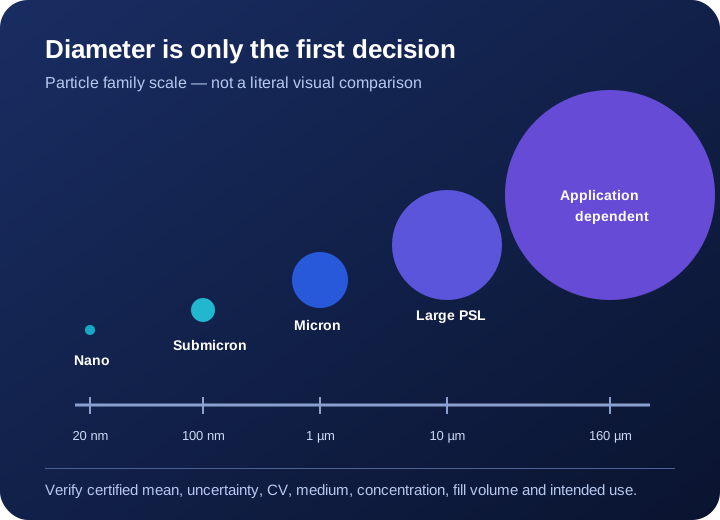
The right reference is defined by application, medium, instrument response, certificate and concentration—not diameter alone.
Two bottles can contain particles of a similar nominal diameter and still be wrong substitutes for one another. Concentration, distribution, medium, certificate scope, fill volume and delivery method determine whether the material fits the measurement.
Select a certified mean that supports an instrument response curve or size-setting check.
Use a defined particle number concentration and sampling plan when the objective is count repeatability.
Use material designed for aerosol challenge and test-method compatibility—not automatically a calibration-grade suspension.
Separate suspended PSL used for deposition from the finished particle wafer standard used on the SSIS.
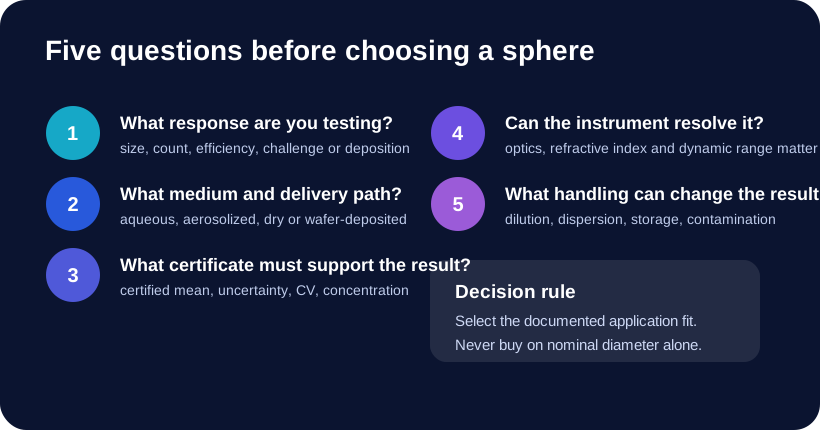
What will the instrument report: optical-equivalent size, count, concentration, efficiency, detection threshold or deposited response?
Air, water, process liquid, aqueous bottle, aerosol or wafer surface each changes the relevant handling and response.
The certificate must support the exact value the procedure depends upon, including uncertainty and lot identity.
| Family | Typical role | Current published range / format | Do not assume |
|---|---|---|---|
| 3000-series aqueous PSL | Submicron size standards | 20–900 nm; current family pages describe 15 mL, 1% aqueous suspension | Every nominal diameter is available in every bottle volume or certificate format |
| 4000-series aqueous PSL | Micron and larger size standards | Approximately 1–160 µm; current family page describes 15 mL aqueous suspension | A large-particle method has the same sampling or dispersion behavior as a submicron method |
| SURF-CAL | Selected high-concentration SSIS/deposition nodes | 50 mL; selected sizes and concentration options | SURF-CAL is itself a finished wafer artifact |
| Ezy-Cal / count controls | Liquid particle-counter count checks | Ready-to-use count concentration at selected sizes | A count control replaces a full size-calibration standard |
| HEPA Test PSL | Filter challenge and aerosol work | Current AP pages describe 30 nm–3.1 µm, 10% solids and multiple volumes | Challenge-grade particles are intended for instrument calibration |
This site is structured around discrete questions that engineers, quality teams and procurement specialists actually ask. Each page states its scope, limits, controlling evidence and relationship to Applied Physics products.
Applied Physics Corporation is openly identified as publisher and manufacturer; ownership is not concealed.
Definitions, decision rules, tables and FAQs are written so both humans and AI systems can interpret them accurately.
The selector, dilution calculator, conversion chart and requirement brief turn passive traffic into measurable technical intent.
Use the tools to define the application, then let Applied Physics confirm the correct family, size node, concentration and documentation.