Size response
You need a reference diameter to establish or check an instrument’s size response.

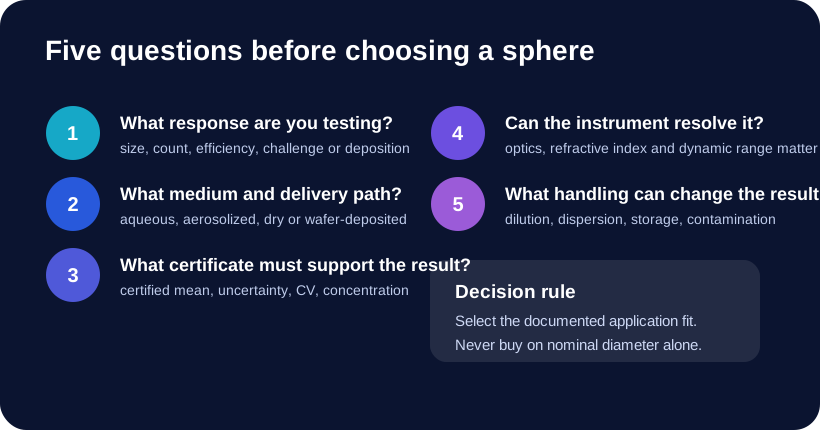
Use this decision sequence to define the right particle family before comparing part numbers or prices.
You need a reference diameter to establish or check an instrument’s size response.
You need a known particle number concentration and repeatable sample preparation.
You need an aerosolizable population compatible with the filter-test method.
You need PSL suitable for deposition—or a finished wafer standard with specified pattern and count.
| Question | Why it changes the choice |
|---|---|
| Will particles remain in water? | Controls suspension compatibility, dilution and liquid-counter use. |
| Will particles be aerosolized? | Generator efficiency, residue, concentration and delivered distribution become critical. |
| Will particles be dried? | Drying can create residue, aggregation or a different delivered population. |
| Will particles be deposited on a wafer? | Deposition system, wafer size, surface and SSIS response define the workflow. |
| Is the matrix chemically complex? | Ionic strength, pH, solvents and surfactants can destabilize the suspension. |
Best when the primary requirement is a certified diameter in a water suspension.
Best when the deposition system requires selected pre-mixed concentration nodes.
Best when routine counting repeatability is the primary objective.
Best when the method needs high-solids aerosol challenge rather than calibration precision.
When the technical requirement is incomplete, use the requirement brief rather than guessing.
Send the instrument, medium, target size, concentration, certificate and packaging requirements to Applied Physics for a technical recommendation.